

Physics Class 9th Chapter 1 2025: Best Key Concepts of Physical Quantities and Measurement
Are you looking to find the Physics Class 9th Chapter 1 Notes or the full explanation of the Physical Quantities and Measurement? You’re in the right place!
We have made the best overview and notes of Physics Class 9th Chapter 1 that will assist you to score full marks in your Physics examination revising and understanding the chapter in the best way possible at PhysicsWallaaa.com.
Introduction
Physics is a science that deals with matter, energy and the laws that govern their interaction. It gives us the knowledge of everything, even how an apple falls to the ground and how the planets revolve in the heaven.
The introductory chapter of 9 th class Physics, which is known as the Physical Quantities and Measurement, forms the basis of the whole subject. It educates on the methods of measurement, comparison and expression of various quantities of physical quantities in a precise manner by scientists. After acquiring knowledge on this chapter, it becomes very easy to solve numerical problems and also do experiments.
1. What Are Physical Quantities?
The definition of a physical quantity is that something that can be measured and represented as a result in a number alongside a unit. For example:
- Length = 5 meters
- Time = 10 seconds
- Mass = 2 kilograms
In this case there are two components of every physical quantity:
- Numerical Value : the number (e.g. 5, 10 or 2).
- Unit : the unit that is used to make comparisons (e.g. meters, seconds, kilograms)
2. Types of Physical Quantities
There are two major types of physical quantities:
a. Base Quantities
These are also the basic quantities independent of others. The International System of Units (SI) stipulates seven bases quantities:
| Base Quantity | SI Unit | Symbol |
| Length | meter | M |
| Mass | kilogram | Kg |
| Time | second | S |
| Electric Current | ampere | A |
| Temperature | kelvin | K |
| Luminous Intensity | candela | Cd |
| Amount of Substance | mole | mol |
b. Derived Quantities
They are acquired by obtaining base quantities by mathematical relationships. For example:
- Area = length x width – unit m2
- Volume = width x length x height – unit m3
- Speed = distance / time – unit m/s
- The force = mass acceleration -newton (N)
3. The International System of Units (SI Units)
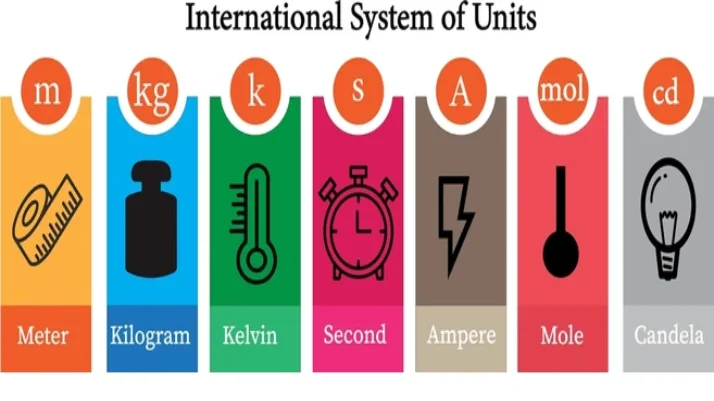
The world standard of measurement is the SI System (Systeme International d’Unites). It provides the uniformity, accuracy and consistency of scientific work internationally. As in example, in Pakistan, the UK, or Japan, the meter (m) or the second (s) have the same meaning everywhere, and thus science is universal.
4. Measuring Instruments and Their Uses
The length, mass, time, and temperature are measured with varying accuracy with the help of different instruments.
a. Measuring Length
We use a meter rod or a ruler to do it on a daily basis. However, when great precision is needed, they employ specialized equipment such as the Vernier Calipers and Screw Gauge.
b. Vernier Calipers : Measuring Small Lengths Precisely
Internal and external diameters of small objects (such as a pipe or a cylinder) and the depth of containers are measured with a Vernier Caliper. It provides accuracies of readings to the tune of 0.01 cm.
It has:
- A main scale (like a ruler)
- A vernier (finer reading) scale.
- Jaws for holding the object
How to use Vernier Calipers:
- Grasp the item in the jaws.
- Record the scale of the main scale in front of zero of vernier scale.
- It is important to note that this division on the vernier scale should coincide with a line of the main scale.
- Divide the number by the smallest number (0.01 cm) by multiplying.
- Added both of the readings to obtain the final value.
- Least Count (L.C.) = 0.01 cm
This renders Vernier Calipers among the best tools that can be used to measure lengths accurately.
c. Screw Gauge – Measuring Extremely Small Thickness
A Screw Gauge is applied in measuring the diameter of wires or the thin sheets. It is more precise even than the Vernier Caliper–to 0.001 cm.
It consists of:
- A U-shaped frame
- A screw spindle
- A circularly scaled thimble.
- A pitch scale on the sleeve
How it works:
As the thimble is turned, the screw goes either forward or backward gripping the object between the anvil and the spindle. The pitch scale reading and the circular scale reading multiplied by the least count (0.001 cm) are added together to obtain the total reading.
This is what makes it best suited in sensitive measurements that demand high accuracy.
d. Measuring Mass
Mass informs us of the quantity of matter that an object has. It is among the seven fundamental quantities in physics.
Instruments that are commonly used are:
- Beam Balance: The standard weights are used in this traditional device.
- Electronic Balance: Gives a fast and precise digital indication.
- Spring Balance: Springs measure weight (force due to gravity) and not mass.
- SI unit of mass = kilogram (kg)
e. Measuring Time and Temperature
- Time is measured using stopwatches, digital timers, or atomic clocks (the most accurate).
Digital temperature sensors or thermometers determine temperature in SI unit Kelvin (K).
The importance of Accurate Measurement.
physics is founded on observation supported by some exact data. In the absence of standard units and instruments, the interaction between scientists and engineers would be in a state of disorder.
In real life:
- Bridges and machines are constructed by engineers through accurate measurements.
- Medical doses are based on correct readings.
- Astronomers make use of precise computations to observe heavenly bodies.
Therefore, knowledge of the Physical Quantities and Measurement is the initial move towards being a real physicist.
Physics is based on accurate measurement. These are some of the usually used measuring instruments discussed in Chapter 1:
| Instrument | Quantity Measured | Example Use |
| Ruler/Measuring Tape | Length | Measuring a table’s length |
| Vernier Calipers | Small lengths | Measuring diameter of a coin |
| Screw Gauge (Micrometer) | Very small lengths | Measuring wire thickness |
| Stopwatch | Time | Determining reaction time or race time. |
| Physical Balance | Mass | Measuring mass of an object |
5. Accuracy, Precision, and Types of Errors
Although the instruments are the best, there are slight variations in readings that could be presented. These are called errors.
Accuracy: The proximity of the measured value and the actual value.
Precision: The distance between repeated measurements.
6: Types of Errors
- Systematic Errors : These are errors that are as a result of bad instruments or incorrect calibration.
- Random Errors : Are caused by uncertainties in changes (such as temperature or human reaction time).
- Human Errors : due to inattention or inaccurate reading (e.g. parallax error).
Physicists repeat measurements and determine their average in order to minimize errors.
7. Significant Figures
The digits in a measure that indicate the accuracy of a measurement are significant.
E.g. 3.142 contains four digits of significance.
Significant figures rules make sure that the accuracy of the calculations is adequate.
8. Scientific Notation
Physics is highly likely to work with either very large or very small numbers. In order to make them easier, we employ scientific notation that represents numbers as powers of 10.
Examples:
- Speed of light = 3 x 10⁸ m/s
- Radius of hydrogen atom = 1 x 10⁻¹⁰ m
Calculations have been simplified and made to be standardized using scientific notation.
9. Prefixes

In physics, certain quantities are either too big or too small to be conveniently represented in base units. For example:
- Planets are separated by millions of meters,
- The size of an atom is measured in billions of meters.
Scientists can use prefixes of SI units to easily deal with such numbers. These prefixes are used to indicate the powers of ten and enable writing and reading values to be far easier.
Common SI Prefixes
| Prefix | Symbol | Multiplier (Power of 10) | Example |
| Tera | T | 10¹² | 1 terameter (Tm) = 10¹² m |
| Giga | G | 10⁹ | 1 gigahertz (GHz) = 10⁹ Hz |
| Mega | M | 10⁶ | 1 megawatt (MW) = 10⁶ W |
| Kilo | k | 10³ | 1 kilometer (km) = 1000 m |
| Hecto | h | 10² | 1 hectopascal (hPa) = 100 Pa |
| Deca | da | 10¹ | 1 decameter (dam) = 10 m |
| Deci | d | 10⁻¹ | 1 decimeter (dm) = 0.1 m |
| Centi | c | 10⁻² | 1 centimeter (cm) = 0.01 m |
| Milli | m | 10⁻³ | 1 millimeter (mm) = 0.001 m |
| Micro | μ | 10⁻⁶ | 1 micrometer (μm) = 0.000001 m |
| Nano | n | 10⁻⁹ | 1 nanometer (nm) = 0.000000001 m |
| Pico | p | 10⁻¹² | 1 picometer (pm) = 0.000000000001 m |
10. Importance of Measurement in Physics
Measurement is not numbers but it is all about knowing nature in the exact manner.Everything in physics is pegged on correct measurement, whether it is calculating the distance to the moon or measuring the charge of an electron.That is the reason the chapter is regarded as the keystone to the advanced subjects such as motion, forces, and energy.
Why This Chapter Is So Important
Develops theoretical knowledge of the way physics experiments are carried out.
- Assistance with the correct solving of numbers.
- Enhances good lab skills and sensitivity to accuracy of measurement.
Tips For Students
Most exam papers include short questions like “Define least count”, “Write two types of errors,” and “Name the SI units of base quantities.” So, memorize definitions, examples, and units carefully.
Important Short and Long Questions
Important Short Questions and Long Questions are given bellow:
Short Questions
Q1: What is Physics?
Q2: What is meant by a physical quantity?
Q3: What are the two types of physical quantities?
Q4: Define base quantities and give examples?
Q5: What are derived quantities? Give examples?
Q6: What is the International System of Units (SI)?
Q7: Write the seven base quantities and their SI units.
Q8: What is meant by a least count?
Q9: What is a vernier caliper used for?
Q10: What is a screw gauge?
Q11: What is meant by accuracy and precision?
Q12: What are errors in measurement?
Q13: What are the main types of errors?
Q14: What are significant figures?
Q15: What is scientific notation?
Long Questions
Q1: Explain base quantities and derived quantities with examples.
Q2: Describe the importance of the International System of Units (SI).
Q3: Explain the difference between accuracy, precision, and error in measurement.
Q4: Explain the working and use of vernier calipers.
Q5: What is a screw gauge and how is it used?
Q6: Write a note on significant figures and scientific notation.
Q7: Why is measurement important in Physics?