Physics Class 9 Pairing Scheme: 2025 & 2026 Latest Updates
Do you want the Physics class 9 Pairing Scheme 2026? You are on the right page.
In this case we have uploaded the Physics class 9 pairing scheme 2025 & 2026 which is equally useful to all boards of Punjab. These Punjab Boards include BISE Lahore, BISE Multan, BISE Gujranwala, BISE Sahiwal, BISE Sargodha, BISE DG Khan, BISE Faisalabad and BISE Jammu Kashmir. The perfect quality of 9 th class physics pairing scheme 2025 will also be of great use to you to score so high marks in the exam.
Must Read: Physics class 10th Pairing Scheme
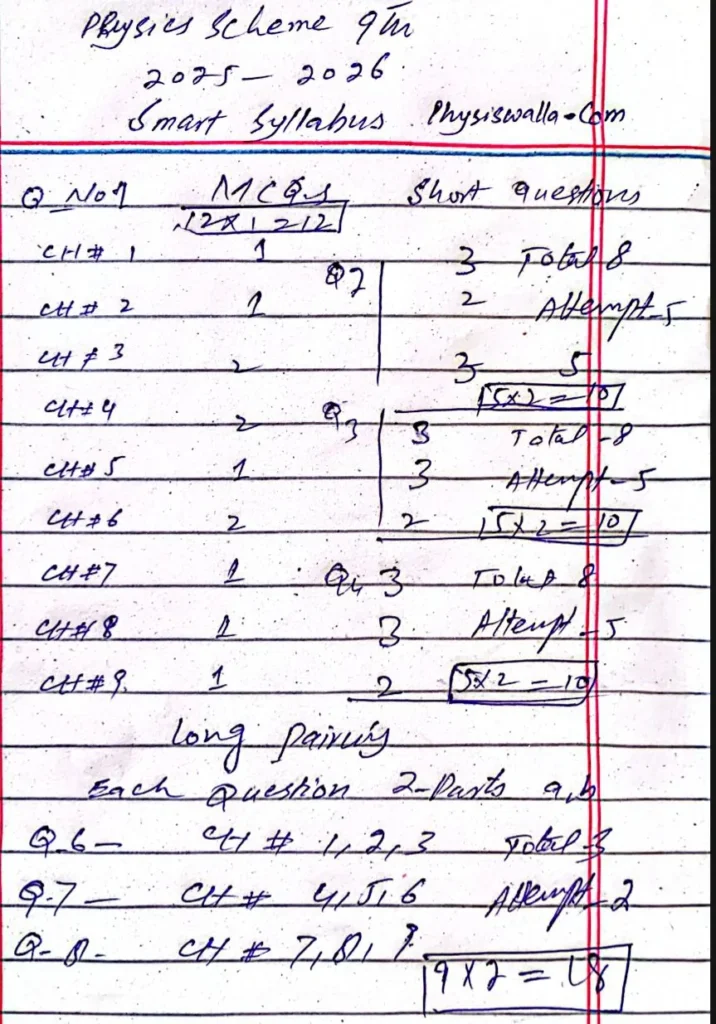
Latest Update
Recently the Punjab Board has announced the new paper scheme of 9 th class. The Physics class 9 pairing scheme 2025 & 2026 is also available on this page of physicswallaaa.com and can be viewed at ease by candidates.
Physics class 9 pairing scheme 2025 & 2026 Your Complete Exam Preparation Guide
The Physics class 9 pairing scheme 2025 & 2026 can be used by students as a guide to pairings in physics 9th class in 2025. Having the final list of topics and chapters, the students get to know what to expect in the examinations. Besides, the pairing scheme provides the distribution of the questions per chapter in the objective and subjective section. The students can make preparations based on the weight of each chapter.
Physics class 9 pairing scheme 2025 for Punjab Board (English & Urdu Medium)
Punjab board students search 9th class physics pairing scheme 2025. Consequently, here is the Physics class 9 pairing scheme. The ninth course in physics consists of nine chapters. By examining the scheme, one can get a better insight into the paper. This scheme equally applies to English and Urdu medium students. Through this information, the student will be in a position to know the pattern of the paper in 2025.
The physics 9th grade textbook consists of nine chapters. Physics Scheme 2025 (9 th grade) has the chapters that the students will be required to study before the end of year exams. Adhering to the structure of this book will make you used to the pattern.
9th Class Physics Paper Pattern 2025 & 2026
9th class physics paper is divided into sections i.e.
Objective and Subjective. Objective paper is separate and collected after 15 minutes. While subjective time is 1:45 hours. Total marks of the paper are 60 Marks.
Objective Part (12 Marks)
(12 MCQs x 1 Mark Each = Total 12 Marks) – Objective
portion will contain 12 MCQs. Each MCQs carries 1 Mark.
Total Marks are 12.
Subjective Part (48 Marks)
Subjective portion is divided into 2 parts i.e. Short Questions and Long Questions.
Part 1 (Short Questions) will contain 3 main questions, each question will contain 8 short questions. Attempt any 5 out of 8 short questions from each Question 2,3 and 4. (15 SQs x 2 Marks Each = Total 30 Marks)
Part 2 (Long Questions) will contain three long questions and you have to attempt any 2 of them.
Each long question contains two parts, one is theoretical and other is numerical. You have to solve both parts of the same question. (2 LQs × 9 Marks Each = Total 18 Marks)
Conclusion
The Physics class 9 pairing scheme 2025 & 2026 is an essential tool for students who want to score high marks in their board exams. It provides a clear structure of how the paper will be divided between objective and subjective sections, helping students plan their preparation strategically.
With the pairing scheme available for all Punjab Boards, including BISE Lahore, Multan, Gujranwala, Sahiwal, Sargodha, DG Khan, Faisalabad, and Jammu Kashmir, students can study efficiently and focus on the most important topics. Following this scheme not only saves time but also boosts confidence by giving a clear understanding of the exam pattern. Stay consistent, revise smartly, and use this pairing scheme from physicswallaaa.com as your complete guide for achieving top grades in Physics.